

For decades, falling birth rates were blamed mostly on lifestyle and delayed parenthood. But a disturbing new pattern is emerging — male infertility is on the rise, and one of the silent culprits may be pesticides hidden in everyday food.
Recent scientific studies and reports, including a 2025 Times of India investigation, have drawn attention to how chemicals used in agriculture may be slowly eroding male reproductive health. Scientists warn that this isn’t a marginal issue anymore — it’s a public health crisis in the making.
Table of Contents
Evidence Points to Pesticides
A 2023 global meta-analysis published in Human Reproduction Update showed that average sperm counts have plummeted by over 50% since the 1970s. Researchers point to environmental toxins — particularly endocrine-disrupting pesticides — as one of the key drivers.
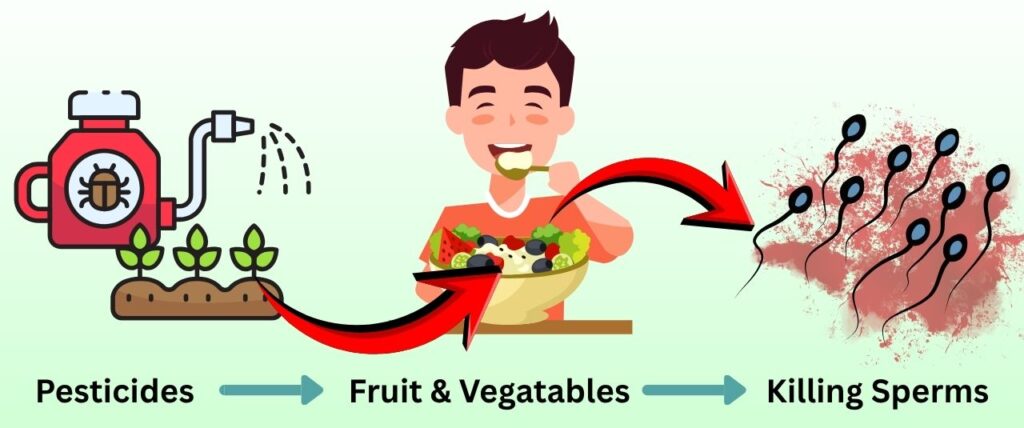
These chemicals, designed to kill pests and increase food productivity, are now infiltrating the human body through fruits, vegetables, and grains. Once inside, they mimic or block hormones, disrupt testicular function, and ultimately reduce sperm count and motility.
“Pesticide residues are now part of our food chain, and they are accumulating in our tissues,” said a senior scientist at the National Institute for Research in Reproductive and Child Health (NIRRCH), Mumbai. “We are seeing a clear link between high pesticide exposure and low semen quality.”
Related: Microplastics in Human Reproductive Fluids: A Wake‑Up Call for Fertility
The Science Behind the Decline
Several studies have connected specific pesticide groups — organophosphates, organochlorines, and carbamates — to male reproductive dysfunction:
- Harvard T.H. Chan School of Public Health (2015): Consuming high-pesticide residue fruits and vegetables had 49% lower sperm counts and 32% fewer morphologically normal sperm.
- NIRRCH Study (2021): Traces of organochlorine pesticides were found in seminal plasma, directly associated with oxidative stress and DNA fragmentation.
- Environmental Health Perspectives (2022): Agricultural workers exposed to pesticides had significantly lower testosterone levels and higher infertility rates.
These findings confirm that the crisis is not limited to industrial or farming communities — it’s spreading through dietary exposure.
Related: Why Regular Check-ups during Pregnancy Is Essential? Know Everything
How Pesticides Damage Male Reproductive Health
Experts say the process is multi-layered:
- Hormonal Chaos: Endocrine-disrupting pesticides imitate estrogen or block testosterone, confusing the body’s hormonal balance.
- Oxidative Assault: These chemicals generate free radicals, damaging sperm DNA and lowering motility.
- Testicular Damage: Chronic exposure can inflame or harm the seminiferous tubules, where sperm are produced.
- Epigenetic Effects: Some studies even suggest that pesticide exposure can alter gene expression, potentially affecting fertility in future generations.
Dr. B. Pal, an andrology specialist in Kolkata, notes that the issue is being underreported: “Infertility clinics are seeing an increasing number of men with no obvious medical cause — but when we test for oxidative stress or toxin exposure, the markers are consistently high.”
Related: Bryan Johnson’s Detox Method: Know How to remove microplastics from semen
India’s Unique Challenge
India’s reliance on chemical pesticides makes the problem more complex. According to government data, the country uses over 60,000 metric tonnes of pesticides annually, with residues often found in market produce. Even washing or peeling fruits may not eliminate all traces.
Environmental watchdogs have raised concerns about banned pesticides like DDT and endosulfan still being detected in food samples. In many rural areas, farmers spray crops without protective gear — leading to direct inhalation and long-term exposure.
Public health experts fear this toxic load may be a silent driver behind the rising infertility rates among young Indian men, particularly in urban centers.
Also read: Why “Stroke in Young Adults” Is Rising in India — Symptoms, Risks & Prevention
Medical Treatments: Tackling Male Infertility
Despite the grim data, medical science offers multiple interventions for men struggling with infertility.
- Hormonal and Medical Therapy – If hormonal imbalance or low testosterone is detected, endocrinologists can restore balance using medications or gonadotropin therapy.
- Microsurgical Treatment – Correcting conditions such as varicocele can improve sperm production.
- Assisted Reproductive Technology (ART) – Procedures like IVF (In Vitro Fertilization) and ICSI (Intracytoplasmic Sperm Injection) can help couples conceive even when sperm count is critically low.
- Antioxidant Therapy – Supplements containing vitamin E, Coenzyme Q10, zinc, and selenium are often prescribed to combat oxidative damage.
Experts emphasize that identifying the root cause—whether it’s hormonal, genetic, or environmental—is critical for effective treatment.
Important News: Dr Sivaranjani Santosh and the FSSAI ORS Ban: A Landmark Victory Against Fake ORS Drinks
The Role of Lifestyle and Natural Remedies
Health experts suggest that alongside medical care, lifestyle modification plays a vital role in recovery and prevention.
- Choose Organic Produce: Reduce pesticide intake by buying organic or thoroughly washing produce with baking soda or vinegar solutions.
- Adopt an Antioxidant-Rich Diet: Include foods like spinach, tomatoes, berries, and nuts to combat oxidative stress.
- Ayurvedic and Herbal Support: Traditional herbs like Ashwagandha, Shilajit, and Gokshura have shown promise in improving sperm count and motility.
- Exercise and Mindfulness: Regular exercise, yoga, and stress control improve testosterone levels naturally.
- Avoid Plastics and Heat Exposure: Storing food in glass or metal containers and avoiding heat on the lap (like laptops) helps protect reproductive health.
Naturopaths emphasize detoxification as an essential step — cleansing the liver and kidneys can help the body eliminate toxins and reduce pesticide burden.
Related Health Article: Natural Relief for Chronic Constipation: Diet Strategies That Work
Preventive Measures and Public Awareness
Doctors warn that self-medication or delay in testing can worsen the problem. Many men avoid seeking help due to social stigma, assuming infertility is a “female issue.” However, statistics reveal that male factors contribute to nearly 50% of all infertility cases.
Regular screening, early diagnosis, and public awareness about pesticide-free diets are vital. Health campaigns encouraging safe agricultural practices could also slow down this alarming trend.
Diagnosis and Solutions at Dhanwantari Diagnostics
To address the growing need for reliable testing, Dhanwantari Diagnostics — located in Diamond Harbour, Kakdwip, and Amtala — provides advanced fertility screening and male reproductive health evaluations.
Key Diagnostic Facilities Include:
- Semen Analysis: Assessing sperm count, motility, and morphology.
- Hormone Panel Testing: Measuring testosterone, FSH, LH, and prolactin levels.
- DNA Fragmentation Test: Evaluating sperm DNA integrity.
- Toxicology Screening: Identifying exposure to heavy metals or pesticides.
- Scrotal Ultrasound: Detecting structural or vascular problems.
Patients receive personalized counselling and treatment guidance, integrating medical science with holistic lifestyle recommendations.
📍 Dhanwantari Diagnostics
- Diamond Harbour Branch: Near Subhasgram High School, South 24 Parganas
- Kakdwip Branch: Opposite Kakdwip Bus Stand
- Amtala Branch: Beside SBI, Amtala More
📞 Helpline: +91-8984600600
🌐 Facebook: facebook.com/DhanwantariDiagnostics
The Bottom Line
The data is clear: male infertility is not just a lifestyle disorder anymore — it’s an environmental emergency.
As pesticide residues continue to enter our food chain, men are silently paying the price with their reproductive health.
Experts agree that urgent public health action is needed to reduce exposure, improve awareness, and promote organic, toxin-free food production. For individuals, regular testing, timely treatment, and conscious lifestyle choices remain the best defense.
As one fertility specialist put it:
“We can’t stop eating — but we can start eating responsibly. Awareness is our first line of protection against an invisible threat.”
References: Metabolites, Toxicology Letters, Scand J Work Environ Health, News Medical, NBC News